Showing posts with label Play. Show all posts

Saturday, January 5, 2013

Movie: Les Miserables

Director: Tom Hooper
Release Date: December 25, 2012
Studio: Working Title Films, Relativity Media
Starring: Hugh Jackman, Russell Crowe, Anne Hathaway, Eddie Redmayne & Amanda Seyfried

2012 Poster - Universal Pictures
I feel like a bit of a fraud writing this review. I have never read the original novel written by Victor Hugo in 1862 and I have never watched the famous musical production of Les Miserables. But I did see the most recent musical film adaption on New Year's. So I can tell you what I have experienced.

I do enjoy a great musical on film. Moulin Rouge! (2001) and The Phantom of the Opera (2004) happen to be two of my favourite movies of all time. And it isn't just the singing. These two films have some of the most beautiful costumes and settings that truly transform you to a different time and place. A musical film creates imagery that isn't possible to do on stage. From what I hear, the recent movie of Les Miserables apparently has a similar affect on the audience that the stage just couldn't produce.

Les Miserables as a film is beautiful. It opens the audience's eyes to the extreme poverty of this period in France. There is no assistance and no way to move up in life. With nothing and no hope for a future, the impoverished of France seek desperate measures to survive.

The story begins with the main character Jean Valjean's (Jackman) release from prison by a guard named Javert (Crowe). Valjean is placed on parole and unable to receive any form of work under his current conditions. Starving and freezing, Valjean is found by an old bishop who feeds him and allows him to rest in his home. During the night, Valjean steals the bishop's silver and flees the home. After being caught by officers, the bishop insists that he gave Valjean the silver and that he actually forgot to take the candlesticks. Overwhelmed by the bishop's kindness, Valjean decides to change his life, break parole, and start fresh under a new name.

From here, he begins his own factory and becomes a wealthy man. After a worker, Fantine (Hathaway) is fired without just cause, forced into prostitution, and dies from disease, he vows to take care of her daughter, Cosette. Valjean never reveals his past to Cosette, but it leaves them constantly on the run after Javert discovers his true identity. Cosette grows up to be beautiful and naturally Hugo has her fall for a man who is at the centre of a revolution. Wanting to secure his daughter's happiness and stop a life of hiding,Valjean thrusts himself into the revolution to help save the young man.
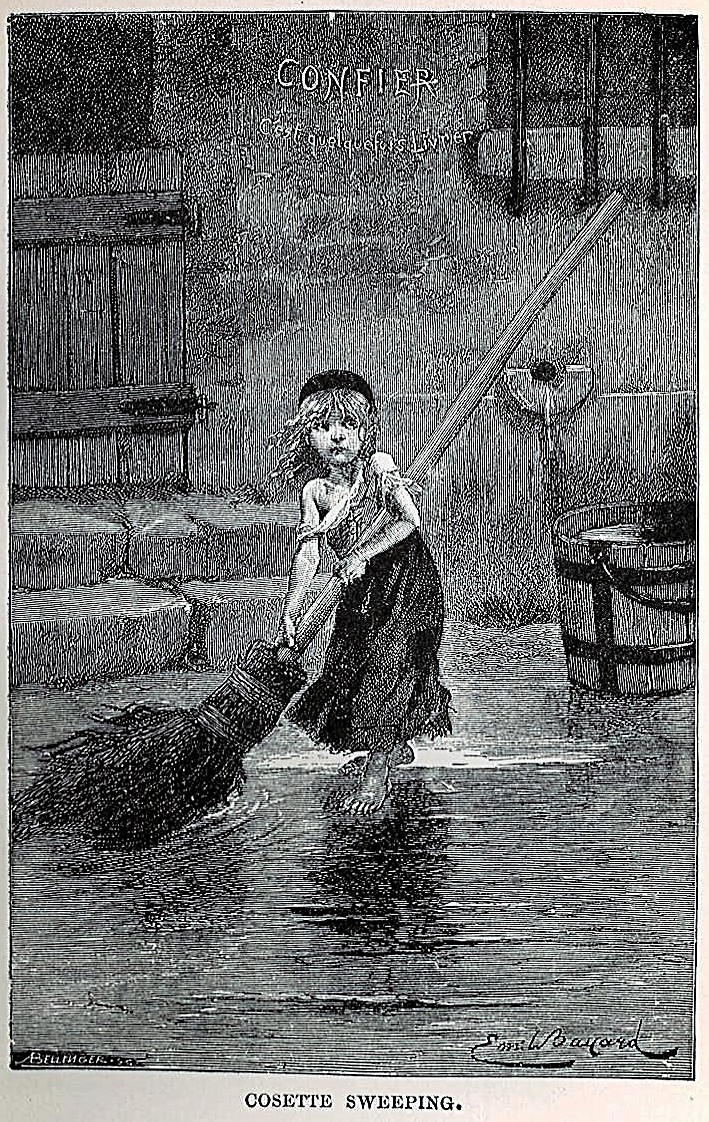
Original Cover by Emile Bayard - 1862

It is a complicated plot line that needs to be followed carefully. It is also being told all through song...and I mean ALL through song. Now as I mentioned previously, I love a good musical, however I do prefer it with some talking. Viewers be warned that Les Miserables features sing-talking, which isn't as fluid as just singing alone. It also became awkward as characters sang/talked/died on screen, which inevitable prolonged the dying. Another negative was that it was about 45 minutes too long and audience members were becoming restless towards the end (at least the two I brought with me).

Overall, it was an experience and a very well-done film with the positives definitely outweighing the negatives.

Tuesday, October 16, 2012

Plays: Ibsen, Shaw, Wilde, and Beckett

This semester I have nine plays to read between two classes. It sounds like a lot of reading, but thankfully they are quick reads as they are required to be performed on stage within a certain time frame. These are the first four plays we have covered in my classes. The first three are realist plays and the final play by Beckett is an example of Theatre of the Absurd.

Play: The Wild Duck
Writer: Henrik Ibsen
Year: 1884
Main Characters: Gregers Werle, Hialmar Ekdal, and Hedvig Ekdal

This is a realist drama that plays with the themes of "claim of the ideals" versus "life-illusions." Hialmar is a man going through the motions of life with his work as a photographer who manages to spend more than he makes. His wife takes care of the day-to-day operations while Hialmar focuses on his "invention." His simple life is suddenly turned upside down with the reappearance of his old friend Gregers. Gregers' father has been helping Hialmar's family financially for years which unknown to him. Gregers decides to take it upon himself to show Hialmar the "claim of the ideals" in regards to his family. This is the theory that truth is better in relationships though sometimes the truth requires forgiveness. Gregers believes Hialmar has been living a "life-illusion." This means he is only seeing the good in his wife, daughter, and life. As a result, Hialmar is forced to recognize his family's flaws and the real reason why Gregers' father has been so generous over the years.


Play: Mrs. Warren's Profession
Writer: George Bernard Shaw
Year: 1893, 1902
Main Characters: Mrs. Kitty Warren, Vivie Warren, and Sir George Crofts

Mrs. Warren's Profession was considered to be an extremely controversial play for the period. Written in 1893, it was kept off the stage until 1902. Shaw was a member of the Fabian Society that believed in socialist ideas. Mrs. Warren's Profession was Shaw's response to a capitalist society. Born into poverty, Mrs. Warren was able to escape her station in society by becoming a madam of a brothel. As the play progresses, we discover she has become very successful and owns multiple brothels throughout Europe with her financial partner, Crofts. The story of Mrs. Warren's Profession mainly revolves around her grown daughter who has been unaware of her mother's income. If you are thinking there are prostitutes on stage or the setting is a brothel, you are completely mistaken. It is only said through dialogue that she owns brothels yet for the period it was still considered inappropriate for stage. It didn't help that Shaw created Mrs. Warren to be likable and the victim of society. Shaw's main point in the play is that it is society's fault that women are driven into these types of occupations to survive and this is not an ideal choice for these women.


Play: The Importance of Being Earnest
Writer: Oscar Wilde
Year: 1895
Main Characters: John Worthing, Algernon Moncrieff, and Cecily Cardew

Compared to the previous two plays reviewed, The Importance of Being Earnest is far more light-hearted and trivial. It isn't meant to be serious, but Wilde still focuses on social aspects. However, he hides them between his humour and wit. Ernest is a person created by a man named John Worthing. He tells his ward, Cecily that he goes to London to meet up with his brother Ernest. While in the city, John lives a double life as Ernest. In the city, he is Ernest. In the country, he is John. His close friend, Algernon (in the city) finds out about the game and decides to go to the country to meet the beautiful Cecily as Ernest. Meanwhile, John has fallen in love with a woman named Gwendolen who believes his real name is Ernest. Confused yet? Probably. Anyways as you can probably guess, both women and both fake Ernests (John and Algernon) end up in the same place with the women arguing over who is the true love of Ernest.


Play: The Endgame
Writer: Samuel Beckett
Year: 1957
Main Characters: Hamm, Clov, Nagg, and Nell

I never ever recommend this play to you. Beckett claimed one of his biggest influences was James Joyce though this couldn't be further from any Joyce I have ever read. There are four characters: Hamm, Clov, Nagg, and Nell. I began reading it thinking that I was missing something. It seem to just to be pointless, nonsensical dialogue. So I googled it and decided to get a brief plot summary off Wikipedia to help me out. It isn't a good sign when Wikipedia can only list the characters and the critical response from the audience. There is NO meaning to this play. It is completely up to interpretation. Scholars have stated that the meaning of the play is that there is no meaning. It is about using/not using language. When discussing it in class, I picture Beckett laughing from his grave about a play he created about absolute nonsense that people have been trying to interpret for over 50 years.

Related Posts Plugin for WordPress, Blogger...