Showing posts with label Book. Show all posts

Wednesday, February 6, 2013

Short Stories: Sherlock Holmes


Book: The Five Orange Pips & Other Cases
Author: Arthur Conan Doyle
Publisher: Penguin English Library
Edition Year: 2012


I have been trying to catch up on my classic literature. Perhaps not so much on the classics, but "Must Reads." I was introduced to a few Sherlock Holmes stories last year during a short stories class. I originally wasn't thrilled by the selection because I am not a fan of the mystery genre. Doyle's stories, however aren't quite like the mysteries we read today. He spins very original and well-written tales of Holmes' work as a detective that are seen through the eyes of his trusted colleague, Dr. Watson. Like Watson, the reader isn't always aware of Holmes' thoughts and therefore he has to spill out his full conclusion at the end of the story.

Like Watson, Doyle's profession was as a medical doctor. He was born in 1859 in Edinburgh, Scotland. He also wrote historical and political pamphlets, but it was the creation of the scientific detective that made him famous. After killing off Holmes in The Adventure of the Final Problem, he was forced to resurrect him due to popular demand.


The Holmes' stories were split into four main collections:

The Adventure of Sherlock Holmes (1892)

The Memoirs of Sherlock Holmes (1894)

The Return of Sherlock Holmes (1905)

His Last Bow (1917)

The twelve stories chosen for this edition were taken from a competition by The Strand Magazine (who originally printed the series) in 1927 asking fans to guess Doyle's favourite stories. Doyle was then asked to list his twelve favourite and to state his reasons. These were some of my favourites from his picks:

1. The Adventure of the Speckled Band

The Speckled Band is a story about a young girl named Helen Stoner who seeks out Holmes after her sister's death. Though she died a few years prior, sudden events have made Helen suspicious of her stepfather. Her stepfather is a doctor with a passion for Indian culture. Having exotic animals roaming the grounds, Dr. Roylett is unpredictable and has a wild temper. Helen has recently become engaged (just as her sister was) and similar and strange events during the night have been occurring, which have her fearing for her life. With a steady income being lost with the engagement of his stepdaughter, Holmes suspects Dr. Roylett is trying to keep Helen's funds secure. Holmes and Watson set out to solve the case, but no one can predict what the doctor is planning except for Holmes.


2. The Adventure of the Red-Headed League

The story begins with a pawnbroker, Jabez Wilson seeking Holmes advice after being tricked out of a job. After his assistant pointed out an ad for an opening in the very exclusive and unknown group called the Red-Headed League, Wilson gets hired to copy out the Encyclopedia. After a few weeks, the League suddenly closes and leaves Wilson out of money. Upset, he seeks council from Holmes on how to find the man who owes him money. Holmes (and the reader) quickly realizes the league was fake to get the red-headed pawnbroker out of his home. Holmes and Watson begin to investigate why the assistant would want him out of the shop.

3. The Adventure of the Devil's Foot

Holmes and Watson are on vacation because of Holmes' poor health and they soon find themselves helping in a major investigation. After playing cards with his siblings, Mortimer Tregennis comes calling the next morning to ask Holmes for help. His sister is dead and his two brothers are being sent to an insane asylum after being found in the same position as the previous night. This investigation involves a mysterious drug, a doctor from Africa, and a unresolved family conflict. Holmes halts his vacation to investigate.



Saturday, January 5, 2013

Movie: Les Miserables

Director: Tom Hooper
Release Date: December 25, 2012
Studio: Working Title Films, Relativity Media
Starring: Hugh Jackman, Russell Crowe, Anne Hathaway, Eddie Redmayne & Amanda Seyfried

2012 Poster - Universal Pictures
I feel like a bit of a fraud writing this review. I have never read the original novel written by Victor Hugo in 1862 and I have never watched the famous musical production of Les Miserables. But I did see the most recent musical film adaption on New Year's. So I can tell you what I have experienced.

I do enjoy a great musical on film. Moulin Rouge! (2001) and The Phantom of the Opera (2004) happen to be two of my favourite movies of all time. And it isn't just the singing. These two films have some of the most beautiful costumes and settings that truly transform you to a different time and place. A musical film creates imagery that isn't possible to do on stage. From what I hear, the recent movie of Les Miserables apparently has a similar affect on the audience that the stage just couldn't produce.

Les Miserables as a film is beautiful. It opens the audience's eyes to the extreme poverty of this period in France. There is no assistance and no way to move up in life. With nothing and no hope for a future, the impoverished of France seek desperate measures to survive.

The story begins with the main character Jean Valjean's (Jackman) release from prison by a guard named Javert (Crowe). Valjean is placed on parole and unable to receive any form of work under his current conditions. Starving and freezing, Valjean is found by an old bishop who feeds him and allows him to rest in his home. During the night, Valjean steals the bishop's silver and flees the home. After being caught by officers, the bishop insists that he gave Valjean the silver and that he actually forgot to take the candlesticks. Overwhelmed by the bishop's kindness, Valjean decides to change his life, break parole, and start fresh under a new name.

From here, he begins his own factory and becomes a wealthy man. After a worker, Fantine (Hathaway) is fired without just cause, forced into prostitution, and dies from disease, he vows to take care of her daughter, Cosette. Valjean never reveals his past to Cosette, but it leaves them constantly on the run after Javert discovers his true identity. Cosette grows up to be beautiful and naturally Hugo has her fall for a man who is at the centre of a revolution. Wanting to secure his daughter's happiness and stop a life of hiding,Valjean thrusts himself into the revolution to help save the young man.
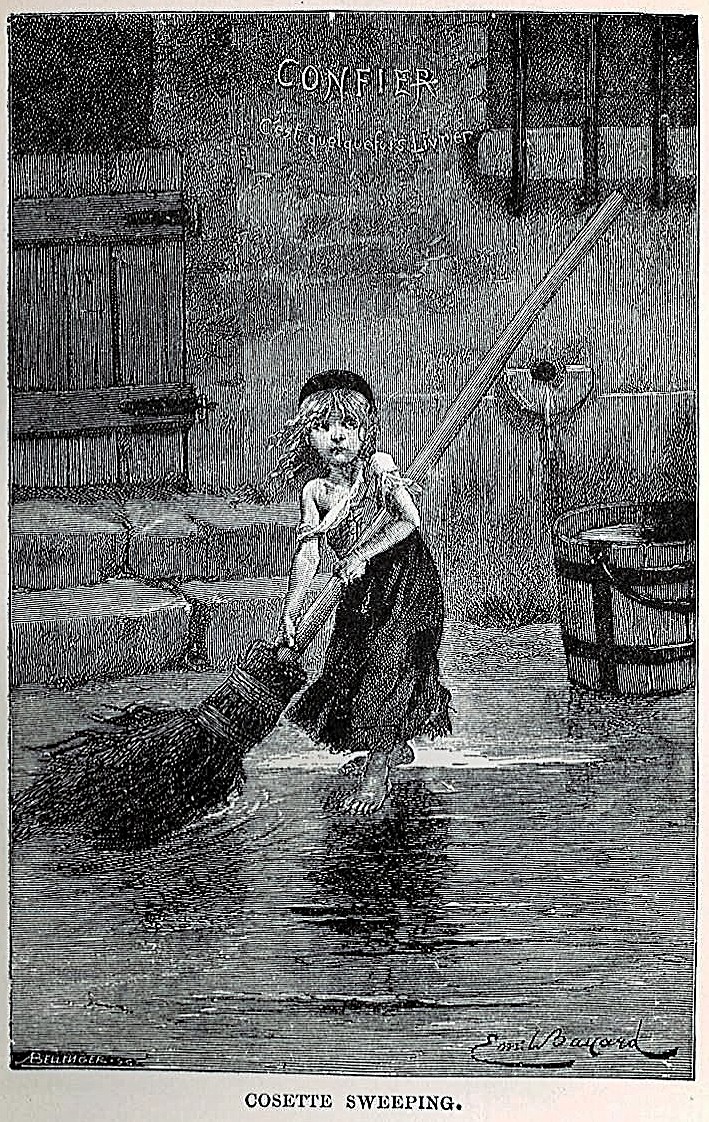
Original Cover by Emile Bayard - 1862

It is a complicated plot line that needs to be followed carefully. It is also being told all through song...and I mean ALL through song. Now as I mentioned previously, I love a good musical, however I do prefer it with some talking. Viewers be warned that Les Miserables features sing-talking, which isn't as fluid as just singing alone. It also became awkward as characters sang/talked/died on screen, which inevitable prolonged the dying. Another negative was that it was about 45 minutes too long and audience members were becoming restless towards the end (at least the two I brought with me).

Overall, it was an experience and a very well-done film with the positives definitely outweighing the negatives.

Friday, October 19, 2012

Book: Gemma

Syren Book Company - 2006

Author: Meg Tilly
Publisher: Syren Book Company
Year: 2006

 
Locked in the trunk of a moving vehicle, 12-year-old Gemma Sullivan makes her way cross-country and reflects on her life up until that point.

Her mother is an alcoholic who loves and hates Gemma depending on her mood. Her mother’s molesting boyfriend, Buddy is the one who got her into this mess. Her sick turtle, Boxcar Julie is hiding in the front seat. But most of all Hazen Wood. Her captor. Her abuser. Her molester. Her fear…

As Hazen Wood drives along the road, he begins to dwell on the old Hazen. The Hazen who had a job. A simple life in California. The Hazen who didn’t capture and fall in love with a 12 year old girl…

This chilling tale, Gemma by author Meg Tilly, takes you into the minds of two characters. One is an innocent girl fighting to survive child abuse and an abduction. The other, the mind of a twisted man who has fallen for a girl and believes his intentions are pure.

Tilly spins these two views together to create a novel you will never forget. Not for children under 15, the novel depicts some very raw and graphic scenes as the reader falls into the mind of a sex predator.

After waking up violently ill for days, Gemma is finally taken to the doctor’s by Hazen. It is here where she receives the help she needs to escape and where the story of Gemma truly begins.
 
As mentioned before, this book has strong sexual content that you may find disturbing. Though it was extremely well-written and like nothing I have ever encountered before, I do recommend it with caution.
 
It should also be noted that a large portion of Tilly's royalties from this book are donated to organizations that help girls who have been through similar situations as Gemma. A good book with a good cause.


Tuesday, October 16, 2012

Plays: Ibsen, Shaw, Wilde, and Beckett

This semester I have nine plays to read between two classes. It sounds like a lot of reading, but thankfully they are quick reads as they are required to be performed on stage within a certain time frame. These are the first four plays we have covered in my classes. The first three are realist plays and the final play by Beckett is an example of Theatre of the Absurd.

Play: The Wild Duck
Writer: Henrik Ibsen
Year: 1884
Main Characters: Gregers Werle, Hialmar Ekdal, and Hedvig Ekdal

This is a realist drama that plays with the themes of "claim of the ideals" versus "life-illusions." Hialmar is a man going through the motions of life with his work as a photographer who manages to spend more than he makes. His wife takes care of the day-to-day operations while Hialmar focuses on his "invention." His simple life is suddenly turned upside down with the reappearance of his old friend Gregers. Gregers' father has been helping Hialmar's family financially for years which unknown to him. Gregers decides to take it upon himself to show Hialmar the "claim of the ideals" in regards to his family. This is the theory that truth is better in relationships though sometimes the truth requires forgiveness. Gregers believes Hialmar has been living a "life-illusion." This means he is only seeing the good in his wife, daughter, and life. As a result, Hialmar is forced to recognize his family's flaws and the real reason why Gregers' father has been so generous over the years.


Play: Mrs. Warren's Profession
Writer: George Bernard Shaw
Year: 1893, 1902
Main Characters: Mrs. Kitty Warren, Vivie Warren, and Sir George Crofts

Mrs. Warren's Profession was considered to be an extremely controversial play for the period. Written in 1893, it was kept off the stage until 1902. Shaw was a member of the Fabian Society that believed in socialist ideas. Mrs. Warren's Profession was Shaw's response to a capitalist society. Born into poverty, Mrs. Warren was able to escape her station in society by becoming a madam of a brothel. As the play progresses, we discover she has become very successful and owns multiple brothels throughout Europe with her financial partner, Crofts. The story of Mrs. Warren's Profession mainly revolves around her grown daughter who has been unaware of her mother's income. If you are thinking there are prostitutes on stage or the setting is a brothel, you are completely mistaken. It is only said through dialogue that she owns brothels yet for the period it was still considered inappropriate for stage. It didn't help that Shaw created Mrs. Warren to be likable and the victim of society. Shaw's main point in the play is that it is society's fault that women are driven into these types of occupations to survive and this is not an ideal choice for these women.


Play: The Importance of Being Earnest
Writer: Oscar Wilde
Year: 1895
Main Characters: John Worthing, Algernon Moncrieff, and Cecily Cardew

Compared to the previous two plays reviewed, The Importance of Being Earnest is far more light-hearted and trivial. It isn't meant to be serious, but Wilde still focuses on social aspects. However, he hides them between his humour and wit. Ernest is a person created by a man named John Worthing. He tells his ward, Cecily that he goes to London to meet up with his brother Ernest. While in the city, John lives a double life as Ernest. In the city, he is Ernest. In the country, he is John. His close friend, Algernon (in the city) finds out about the game and decides to go to the country to meet the beautiful Cecily as Ernest. Meanwhile, John has fallen in love with a woman named Gwendolen who believes his real name is Ernest. Confused yet? Probably. Anyways as you can probably guess, both women and both fake Ernests (John and Algernon) end up in the same place with the women arguing over who is the true love of Ernest.


Play: The Endgame
Writer: Samuel Beckett
Year: 1957
Main Characters: Hamm, Clov, Nagg, and Nell

I never ever recommend this play to you. Beckett claimed one of his biggest influences was James Joyce though this couldn't be further from any Joyce I have ever read. There are four characters: Hamm, Clov, Nagg, and Nell. I began reading it thinking that I was missing something. It seem to just to be pointless, nonsensical dialogue. So I googled it and decided to get a brief plot summary off Wikipedia to help me out. It isn't a good sign when Wikipedia can only list the characters and the critical response from the audience. There is NO meaning to this play. It is completely up to interpretation. Scholars have stated that the meaning of the play is that there is no meaning. It is about using/not using language. When discussing it in class, I picture Beckett laughing from his grave about a play he created about absolute nonsense that people have been trying to interpret for over 50 years.

Saturday, October 13, 2012

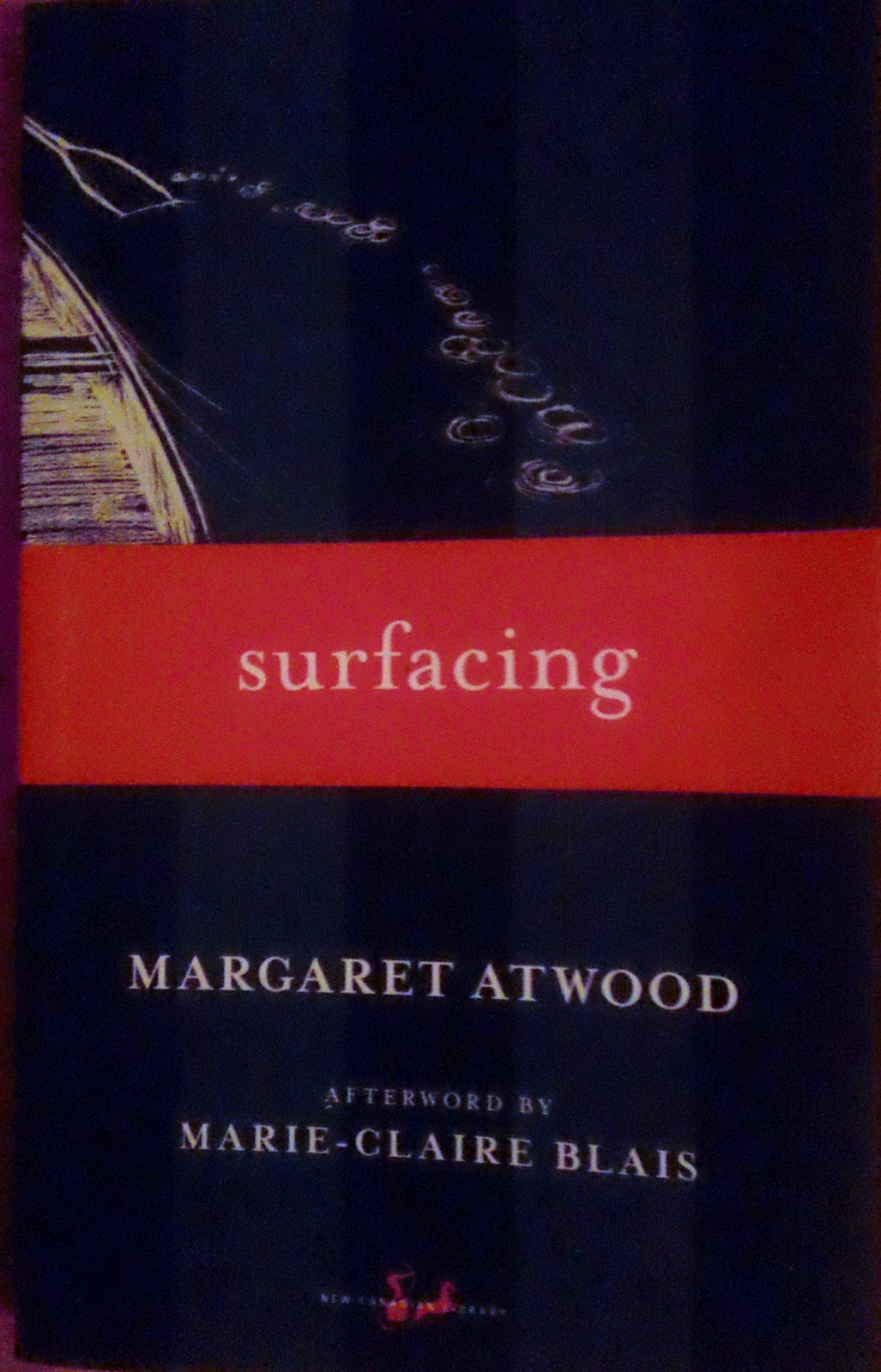
Book: Surfacing


McClellard and Stewart 1st Edition
Author: Margaret Atwood
Publisher: McClellard and Stewart
Year: 1972


Margaret Atwood's Surfacing is a novel about a woman rediscovering her roots in the wooded Quebec landscape. Forced to return to her parents' cottage after her father disappears, the unnamed narrator finds herself flooded with memories. She brings along her boyfriend and another couple to help in her search. As the week progresses, the narrator becomes less connected with reality.

Atwood is Canada's most well-known author. Born in Ottawa in 1939, she resides in Toronto. She began her career as poet and slowly moved onto novels. Surfacing was her second novel, but her best known work would probably be A Handmaid's Tale (1985).

Surfacing was said to be inspired by her childhood trips to Northern Canada. A major focus in Atwood's writing is Canadian identity. She wanted to identify a national literature for Canada that separates itself from American literature. Characters in Surfacing hate Americans and their infiltration on Canadian culture.

Some other themes in Atwood's writing are femininity, environmental concerns, and the importance of storytelling. Much of Canadian literature is about survival particularly in the wilderness.

Her female protagonist is very distant. Her voice is unnatural and unemotional. She seems to be void of love, comfort, and happiness. The narrator also has difficulties deciphering between reality and her imagination. She tells her boyfriend, Joe that she was once married and had a child. It is later revealed that she had an affair with a married man and an abortion. She also dwells on her brother 's drowning at the cottage, but again the reader learns he is actually still alive.

New Canadian Library Edition 1994

Surfacing is a quick read, but lacks any real connection with the audience. With a lot of narration, when character dialogue does occur it isn't enjoyable. Of the four main characters, none are very likable. This book leaves you wanting to avoid a couples cottage week.

Sunday, September 16, 2012

Sunday Favourites: Author - Rona Jaffe


Author: Rona Jaffe
Born: 1931
Dutton - 2003
Died: 2005
Genre: American Fiction
Major Works: 17 Novels

As a fan of the HBO television series Sex and the City, Rona Jaffe reminds me of the original Candace Bushnell. Oh you're not a fan of Carrie Bradshaw? Well, Sex and the City was originally a novel by Bushnell that was adapted into a television show. To me, Jaffe was the pioneer of this four-girl fictional genre.

My first Jaffe book happened to be her last written novel, The Room-Mating Season (2003). The book centres around four girls living and working in New York City during their 20's. They then continue to weave in and out of each other's lives throughout the years.

Though this was her final book, most of her work is structured this way. They feature three to four girls who meet due to circumstances, but create bonds that involve each other for decades. Other great Jaffe novels include Class Reunion (1979) and the sequel After the Reunion (1985). These two books are about four girls who meet at Radcliffe (Jaffe's school) during the 1950s and their lives lead right back to each other in the end.

These novels aren't for everyone and they are geared towards a female audience. However they are entertaining. Unfortunately Jaffe passed away from cancer in 2005, but she lives on in her work.

Sunday, September 2, 2012

Sunday Favourites: Continuing with Memoirs

 Book: Stolen Years

Author: Sara (Plager) Zyskind
Publisher: Signet
Year: 1981

One of my favourite time periods to read about is World War II and the Holocaust. The Holocaust in particular has always interested me. In grade seven, my teacher brought in a Holocaust survivor to speak to the class and her vivid account of the horrifying events always stuck with me. I guess even as a 12-year-old, I couldn’t imagine such atrocities occurring to people whose only crime was being born a Jew. Listening to her tell her story and noting that she wasn’t much older than my own grandmother, made me realize that it really wasn’t that long ago. By high school, our religion class ventured to Detroit to visit the Holocaust museum. Again the speaker left the class speechless and said his main goal was to tell his story so these acts of violence would never happened again.

As a result, I began to read classic Holocaust memoirs such as Night by Elie Wiesel and Anne Frank: A Diary of a Young Girl. Both well written and well known, but nothing seem to impact me as much as Stolen Years by Sara Zyskind. A local used bookstore was closing down in my town and they were having a huge clearance sale. Most paperbacks were 50 cents each. I came across one with a cover of a sullen-looking girl with long braids. The cover was extremely tattered and taped. I added it to my mountainous pile without out much thought.

This virtually unknown book and author became one of my favourite books of all time. It is the story of Sara Plager living in Lodz, Poland in 1939. As an eleven-year-old Jewish girl, her life is turned upside down when the Nazis invade her city. She is forced into the ghetto, narrowly escapes Auschwitz, and finishes up the war at seventeen in a labour camp. How she manages to survive when so many around her are dying is beyond reason. The description of her struggle is unforgettable and like nothing I have ever read before. And I think that is what separated her story from the rest for me. Seven years after reading it, I still remember how much she made me appreciate something as simple as a piece of bread. It is also one of the few books my mom has ever read twice.

This book is extremely rare. I haven’t been able to track down a copy at any bookstore and I have only found a few copies online. Therefore I have only given it out to a few trustworthy people over the years. I remember it also being difficult to find any information about the author. If you want a story to make you appreciate your own life, I suggest tracking down a copy of the Stolen Years.


*Note: Sunday Favourites is an idea I have to force myself to sit down and write a short blog post every weekend no matter how busy I get with school! I might do similar topics for a month. Examples: Book genres, music, desserts, sports, etc. Hope you enjoy and thanks for reading!


Sincerely, Mag

Sunday, August 26, 2012

Sunday Favourites: Memoirs


Credit: HarperCollins

Book: Changing My Mind
Author: Margaret Trudeau
Publisher: HarperCollins
Year: 2010

The memoir of Margaret Trudeau focuses on the period during and after her marriage to former Canadian Prime Minister Pierre Trudeau. Married at the age of 22, Pierre was 29 years older than her. She was quickly thrust into the spotlight as his beautiful, young, wife. She had three children with Pierre and suffered from undiagnosed bipolar disorder during this period.

Her memoir is a blunt account of her actions, decisions, and life with bipolar disorder. She admits both her wrongs and rights during this time. She discusses how she was so sick that she left her kids to hang out with celebrities and to dance at Studio 54. She was able to travel the world with her position and status while trying to bury her illness. She admits to not following doctors' orders with prescriptions while relying on marijuana to cope. The story continues beyond her time in the Canadian political spotlight and through a second failed marriage and the death of her son.

I discovered this book after my mom listened to her speak at a medical conference for work. She was so inspiring that my mom couldn't stop talking about her and I bought her the memoir for Christmas. I soon read the story myself and would recommend it to anyone. Margaret still battles bipolar disorder today, but realizes how much she has to live for. The book will give you a better understanding of mental illness and the people who suffer from it.

Friday, August 24, 2012

Book Review for AmericaJR.com - #hooked

Siloam Books
See my book review on AmericaJR.com:


Book: #hooked
Author: Gregory L. Jantz with Ann McMurray
Publisher: Siloam Books
Year: 2012

Thursday, August 16, 2012

Book: #hooked


Courtesy of A Place of Hope
Author: Gregory L. Jantz with Ann McMurray
Publisher: Siloam
Year: 2012

It seems like everywhere you look these days, everyone and everything is connected to an online site. It often feels that if you aren’t connected you might just be missing out.

When I began reading this book, the irony is that I was disconnected. My Internet had been down for three days. I hate to admit, but I did miss it. Maybe not the social networking sites, but you don’t truly realize how much you use the Internet on a daily basis until it is down. I am constantly looking things up.

This book is about the ever-changing, technology-driven world we live in today. With more forms of technology than ever before, people are spending more time online and connected than in the real world. Dr. Gregory L. Jantz is very frank with his own obsession with his phone and how much time he spends online. He gives examples not only through other people’s point of view, but examples he sees in his own life. This book is intended to be informative and reads similar to a textbook. At the end of each chapter there is a Connection Section that gives tips and exercises to discover your own technology use.

Jantz has published numerous self-help books on topics such as eating disorders, gambling, weight loss, abuse, depression, and anxiety. He is also the founder of The Center for Counselling and Health Resources, Inc. which is a leading health care facility in Seattle. His website, aplaceofhope.com goes into further detail about the center.

In his book, he talks about the new phenomenon of using friend as a verb. The average Facebook user has a least 130 friends, but he questions whether they actually talk to these people or has it become a competition of who can collect the most? He then makes a great reference that perhaps the reason Jesus had 12 disciples is because that was the maximum number of people he could actually devote his time to. It makes you think…how many people on your Facebook do you actually talk to? So many are just mere acquaintances yet we refuse to delete them. Jantz writes, “when friend was a noun, it described someone you knew well and liked, and vice versa” (68). Jantz believes that true friendship is a noun and advises to resist the urge of using friend as verb.

In a chapter titled Just Like Real Life, he discusses that many people are putting more importance on their online life than the life they are actually experiencing. Instead of living in the real world, they are living in a virtual one. How they portray themselves through photos and status updates preoccupies their day. Does that picture make them look fat? Did her comment on his wall sound stupid? Jantz has discovered that the more stressful and chaotic a person’s real life is, the more perfect it appears in their virtual life. You would never know that these people are going through a divorce or that they have an addiction problem. Jantz writes, “Children create fantasy to practice who they will be; adults create fantasy to hide from who they are” (91). Jantz makes a really valid point. When you see a person online who seems to be having the ultimate experiences and the best life, it is often not how it is in reality.

Jantz further goes on to consider our expectations of technology. His section, Instant Download discusses how we expect technology to be fast and efficient. He reminds us of a simpler time of dial-up and being able to make a sandwich while waiting for your computer to load. Back then we were so amazed by computers that the simple functions they did provide us with were worth the wait. In 2012, we have laptops, iPads, Smartphones, etc. and when they fail to download a document within a few seconds, we get irritated with them.

He writes about our fear of being disconnected from technology. Twenty years ago when you left the office at 5pm, you weren’t going to get a sudden call or email from your boss or customers. A person was only called at home if it was an absolute emergency. Now we can be connected to our jobs 24/7. Jantz gives the example of some people not being able to cottage in dead zones due to anxiety about being needed in the workplace.

The only section I was apprehensive about was the final chapter that was titled The Ultimate Filter. This filter is God’s voice and his voice on technology. Jantz uses his own Christian experiences and his role as a Christian therapist to guide the reader through this section. He pulls Biblical passages to help him. Though I am a Christian, Catholics read the Bible contextually and not so literal, which makes it difficult for me personally to read these passages as Jantz intends them to be viewed. I would assume that people of other religions might have the same issues in the final chapter. However Jantz realizes this problem and respects people’s views. He suggests taking what pertains to your own life from this chapter.

Overall #hooked was an interesting read and shed some light on the current issues with technology in our lives. Though I only have a computer and a basic cell phone, it made me think of how we all coped before technology took over and if I remember correctly, we all coped just fine.

Sunday, July 15, 2012

Book Club Book: The Guernsey Literary and Potato Peel Pie Society

Book: The Guernsey Literary and Potato Peel Pie Society
Authors: Mary Ann Shaffer and Annie Barrow
Publisher: Dial Press Trade
Year: 2008


Loved! Loved! Loved this book! Don’t let the confusing title frighten you away from this book. I am still unsure how to properly pronounce Guernsey or what constitutes a potato peel pie, however Mary Ann Shaffer and Annie Barrows will have you wanting to visit and taste both.


 This novel is entirely composed of letters. After her copy of Charles Lamb’s Selected Essays of Elia lands in the hands of Guernsey native Dawsey Adams, Juliet Ashton finds herself being drawn to the small Channel Island. It is January 1946 when Juliet receives the letter from Dawsey thanking her for reselling her copy of the book. He further explains that this book saved him during the German Occupation on the island.


 Juliet, from London, is currently riding the high from her success of her book of collected newspaper columns during the war. When receiving Dawsey’s letter, she not only trying to recover from the effects of the war on the city, but she is also trying to move on and find a new topic to write about. She is intrigued by Dawsey’s mention of the Guernsey Literary and Potato Peel Pie Society and writes back to discover more.

What begins as a fake society to avoid punishment at the hands of the Germans, bands together this group of misfits and acquaintances into a hodgepodge family. Each society member writes to Juliet telling her of their struggles and reads during the war. Juliet begins to fall in love with each person she corresponds with.

One member she feels a particular connection is Elizabeth. Elizabeth is feisty, spirited, and the creator of the Guernsey Literary and Potato Peel Society. She is also the only society member who hasn't contacted Juliet since she was taken by the Germans after trying to save a worker. Left behind is Elizabeth's young daughter who is passed through the homes of members until Elizabeth's hopeful return.

The relationships she develops with the people of Guernsey leads Juliet to the decision to go visit the island herself. What begins as a visit ultimately changes her life through the love of friends, a community, and a small child.

I would definitely recommend this book to anyone who is looking for a quick and easy read. You will not be able to put this book down and you will develop a new appreciation for hand-written letters (especially in our current era of poorly written text messages).

I should also note that this book was started by Mary Ann Shaffer who got sick while writing it and had to rely upon her niece Annie Barrows to finish it. Mary Ann Shaffer died in February 2008 (shortly before the book was published).


Current Read: Trinity by Leon Uris - An Irish epic that has already made me prouder of my Irish roots.

Wednesday, July 4, 2012

Book Review for AmericaJR.com


Book: Sacre Bleu
Author: Christopher Moore
Publisher: HarperCollins Publisher
Year: April 2012


Check out my review for this book at AmericaJR.com: http://americajr.com/news/sacrebleubook0704.html

Tuesday, July 3, 2012

Book: Sacre Bleu


Cover of Sacre Bleu featuring Toulouse-
Lautrec and Bleu
Book: Sacre Bleu: A Comedy D'Art

Author: Christopher Moore

Publisher: HarperCollins Publisher

Year: April 2012


I have started and stopped this review at least a dozen times. I have been struggling to find the right words to describe this book.

What began so well quickly went downhill at an alarmingly fast pace. Should I’ve been surprised? Probably not since Playboy was quoted on the back cover stating, “If there’s a funnier writer out there, step forward.” Should have been my first clue.

Like I said, it started interestingly enough. As someone who studied art history throughout high school and parts of university, I was intrigued by the storyline. It begins with the death of Vincent van Gogh. Van Gogh famously shot himself in 1890 in a field. However no gun was ever retrieved from the site and van Gogh stumbled back to a small French village to die. This is where Moore’s story begins.

Using a fictional main character, Lucien Lessard is a baker by profession and struggling artist by passion. Upon receiving the news of van Gogh’s death, Lucien and his friend Henri Toulouse-Lautrec quickly become suspicious of the circumstances of van Gogh's death. Was it just made to look like a suicide?

Henri Toulouse-Lautrec is just one of the many real-life artists of this period that Moore uses throughout his novel. Some others include Renoir, Pissarro, Manet, Seurat, Monet, Whistler, Cézanne and many more. Their paintings are scattered throughout the story.

Sacre Bleu may also sound familiar to readers. I remember hearing it in a movie as a kid and getting scolded at by mother for repeating it. I later learned it was a French curse word, but it wasn’t until this book that I learned its true meaning. Sacre Bleu refers to the blue cloak that was painted on the Virgin Mary. During the 13th century, it became popular for artists to use expensive and rare ultramarine blue for the painting of Mary’s robe.

These 19th century artists used what was referred to as a colorman to get the colors they needed for their paintings. In Moore’s story, he creates a crooked, little colorman who has weaved his way through all these famous artists’ lives and paintings. Lucien and Toulouse-Lautrec begin to track down their artist friends and discover that each artist had a muse that they were completely enamoured with though their memories are distorted and where the paintings disappeared to is a mystery to them.

Where this story begins to unravel is with the element of magical powers this colorman possesses. Though I have some imagination with stories that use magical elements, Moore leaves out a lot of details and doesn’t explain properly how the Colorman has been affecting famous artists for centuries. Bleu is a spirit/sidekick who becomes these famous muses in all the paintings. As long as the Colorman has some of his ultramarine, Bleu can keep entering new bodies to inspire these artists.

There is a serious lack of flow with the character Bleu. Sometimes she is good and sometimes she bad. As a reader, you are always questioning her motives especially with Lucien. She inspires Lucien through his former love, Juliette.

This novel is supposed to be comical, but it often comes off as crude. Using the word “fuck” to describe every sex scene just seems like a writer who lacks creativity and is just being lazy.

Overall, I would suggest this book with caution. What began as interesting became a nightly punishment to finish.

Map of Paris


Friday, June 29, 2012

Book Club Book: Not Wanted on the Voyage

Book: Not Wanted on the Voyage
``...went in two and two unto Noah into the ark...``
Author: Timothy Findley
Publisher: Viking Canada
Year: 1984


Can you imagine being one of the chosen few to land a coveted ticket on Noah's Ark? What an honour that would be. The entire population is going to wash away and you scored big by being part of the chosen family by God to carry on the human and animal race. While according to Timothy Findley's version of the famous tale, most of the people chosen would have rather been washed away.


Findley (1930-2002) tells his own version of the tale using the Noyes family. The world has become corrupt and God chooses Noah Noyes and his family to carry on. Unlike the Biblical version, this one focuses more on characters.


Main Characters:


Noah: Known as Doctor Noyes, Noah is portrayed a tyrannical ass. Hard on his sons, demeaning towards his daughter-in-laws, and completely disrespectful to his wife, the reader completely looses respect for the aging patriarch from the start. His cat lives in complete fear of him, as he is notorious for using kittens for scientific experiments. As the book progresses, it is discovered that Noah is sexually assaulting his daughter-in-laws and is also becoming senile in the process.


God: God is roughly 700 years old at this point according to Findley. His character is portrayed as tired, cranky, and downtrodden by the current situation on Earth. A flood seems like the easiest solution to eliminate the world's corruption and sins. However it seems like the choosing of the Noyes family is solely based on a past friendship with Noah. At least that is the only way to explain why anyone would choose this dysfunctional family to carry on the human race or maybe its just Findley’s way of portraying a not-so perfect family people can relate to.


Mottyl: Mottyl is the cat and quite frankly the most likeable character in the story. She gives the perspective of the animals prior to the voyage and during the voyage. She is originally denied entry by Noah onto the ship, but is snuck onboard by Mrs. Noyes.


Mrs. Noyes: As the wife of Noah, she is a depressed alcoholic who is constantly being put down by Noah throughout the novel. She does spiteful things towards her husband, however she does have a good heart. She helps her daughter-in-law Emma see her family, she cherishes her cat's company, and she tries to save Emma's sister (though ultimately fails as Noah orders their son to kill her).


There are other secondary characters onboard the ship as well. Noah’s three sons Shem (described to be a worker with little opinion on any matters), Japeth (who has blue skin after an encounter with thieves), and Ham (who is wise and science-minded).


Each son has a wife who plays a significant role. Shem is married to Hannah who is favoured both by God and Noah. Her character is very pious though it is later discovered that she is carrying Noah’s child. Japeth is with Emma who is twelve years old. A major issue during the story is that they have yet to consummate the marriage after a year. Noah comes to a disturbing and horrifying solution on how to fix this problem. Finally, Ham begins the novel single, but discovers a woman in the forest shortly before the floods begin. Her name is “Lucy” and she is Lucifer in disguise. It is Findley’s way of getting Lucifer onboard the ark. Obviously there are still evils in this current world and therefore Lucifer had to have somehow made the journey. No one really questions when Ham decides to marry a mysterious seven-foot tall woman.


This story isn’t for truly devout Christians. At some parts it can be offensive and disturbing. It is a perspective of one man and is meant to be read as fiction. The story of Noah’s Ark in the Bible is actually very brief and this gives the reader a more personal view of the characters involved.

Saturday, April 7, 2012

Movie: The Hunger Games


Movie: The Hunger Games
Director: Gary Ross
Release Date: March 23, 2012
Studio: Lionsgate
Starring: Jennifer Lawrence & Josh Hutcherson

After recently reviewing the novel The Hunger Games, I felt the need to review the film that just came out. I saw it opening night (no not with the crazy people who went at 12:01 am) and with the book fresh in my mind, there were things that I both liked and disliked in the film. If you haven’t seen the movie this might be a good time to stop reading this post. Though I don’t plan to give too much away, I will probably mention some things that might ruin the movie experience for you.

Now I have heard that a lot of people who haven’t read the books absolutely loved it. And to be honest, this does not surprise me. It seems that this book was written to one day become a film. I would also like to mention that I am not one of those fanatical “book to film” haters who completely trash any movie that is not line for line to the book. I know that films can’t be an eight-hour remake of the novel.

Likes:

1. Jennifer Lawrence plays the lead role of Katniss Everdeen, a sixteen-year-old girl from District 12 who offers herself up as tribute to replace her sister from a certain death. Lawrence’s portrayal of Katniss is how I imagined it. Her character is strong and a good example to other girls. She also looks way better with brown hair than she does in real-life as a blond. The role of Peeta was also portrayed very well. There was much criticism by super fans over the casting of Josh Hutcherson. He is shorter with dark brown hair, but the dye job was perfect (like Lawrence, maybe they should stick to their character’s hair colouring) and the best part is the kid can actually act. I have seen him in a few other roles and he does a great job. I was glad that he showed up all the people who doubted him. Some other notable roles were Woody Harrelson as Haymitch Abernathy, Elizabeth Banks as Effie Trinket, Stanley Tucci as Caesar Flickerman, and Wes Bentley as Seneca Crane.

2. In the book, the story is told from Katniss’ point of view. We hear her thoughts and see what she sees. Unlike the book, the movie couldn’t have the main character talking aloud and giving away her position in the Games. As a result, the director showed the point of view of the gamemakers to explain certain aspects of the Games. It was interesting to watch the gamemakers and really worked to the film’s advantage. It wasn’t in the book, but it became a great addition to the story.

3. Again, we are taken out of Katniss’ point of view and we are able to see what the audience is watching on the screen at home. With the colour commentary given by Caesar Flickerman, it gave the moviegoer a realistic view as someone from the audience. With all the reality television we are watching, it really drove home the idea that it was a television game. This lacked in the reading of the book.

4. The sets were extremely well done. They were just how I imagined them (except for the cornucopia). They didn’t skimp anywhere. The poverty of the districts, the elegance of the Capitol, and the arena’s forest were perfect.

5. The romantic scenes between Katniss and Peeta in the film were actually better then the ones in the book. Why? I think it might have been because again we aren’t in Katniss’ head during the film and don’t have to listen to her awkward back and forth. In the book, the reader is dying for Peeta because at some points she is acting for the cameras and other times, she is actually showing true feelings. In the film, the viewer feels like she might actually care for him and isn't playing a role.

Dislikes:

1. The director packed too much in the last 30 minutes of the film. I remember looking at my watch when Katniss discovers Peeta by the river and realizing that there were at least 100 pages of the book left with only 30 minutes of film to go. As a result, things got shortened or worse, they were completely cut out. There was a lot that happened in those last few pages.

2. Some scenes would have been worth omitting to give more time to more important parts. With all the back and forth of the Mockingjay pin, it may have just been easier to pay an actress to play the role of Madge. Her character isn’t that important, but it is more about what the pin represents in future books. I mean the last book is called Mockingjay.

3. There wasn’t enough time spent with little Rue. Katniss spends a few days with Rue, but her role in the film was really not much more than 10 minutes… maybe 15 minutes. I was a Rue fan so I would have liked to have seen more, but the little girl who portrayed her was great.

4. I didn’t like the depiction of the mutts. In the book, they are described as having the eyes of the dead tributes. That aspect of the book wasn’t even touched upon. Also with all the technology available in films today, I would have thought they would have been more realistic and life-like. I mean even real dogs would have been better. 

5. Overall, I was kind of left wanting more. It definitely wasn’t a bad book to film adaptation, but maybe I just went in expecting too much. Something was missing.

I think this will definitely be the most successful of the three films as this was the best of the three books. The other two books were great, but the author’s ideas weren’t as original as in the first novel.

Now that I have written about The Hunger Games for both the book and film, I will wait to review Catching Fire and the Mockingjay. Besides it will give me an excuse to read the series again.

Thursday, April 5, 2012

Book: Unjunk Your Junk Food


Book: Unjunk Your Junk Food
Authors: Andrea Donsky & Randy Boyer
Publisher: Gallery Books
Year: December 2011

Check out my book review for Unjunk Your Junk Food at AmericaJR.com
http://americajr.com/news/unjunkyourjunkfood0404.html

Friday, March 9, 2012

Book: The Hunger Games


Book: The Hunger Games
Author: Suzanne Collins
Year: 2008
Publisher: Scholastic

From past posts it is obvious that I tend to read books that aren’t necessarily on the bestseller lists. Kind of against book-trending norms, I have realized that I usually stay away from the “book of the moment” (with the exception of Harry Potter – which I honestly tried for years to not cave into, but I lost the battle in the end).

This was a similar situation with the recent book trending everywhere I looked: The Hunger Games. I had heard about it and seen it in the bookstore, but never thought much of it. I assumed it was another Twilight, which I managed to avoid over the last few years. After a professor mentioned reading The Hunger Games over the holidays and seeing the trailer online, I gave into the craze and I LOVED IT.

The first book in the series was original and unique. Set in the future state of North America, the nation of Panem consists of the Capitol and twelve distinct districts. After facing a revolt 74 years prior, the Capitol set up a form of entertainment to keep the districts oppressed. Each district would put forth one male and female between the ages of 12-18 to compete against other districts each year. With 24 tributes, they are forced to fight to the death against each other until one emerges as the victor. This is of course broadcasted across the nation on live television.

After her sister’s name was pulled to compete for District 12, the main character, Katniss volunteers to take her place. She sacrifices herself by knowing she will likely meet a certain death. The male tribute from their district is Peeta. The two tributes are both sixteen and have only had run-ins with each other briefly. They are quickly shipped to the Capitol to start the process of the competition. There are opening ceremonies, interviews, training, and skills competitions before they even enter the arena.


Without giving too much of the plot away, the two tributes from District 12 are forced to act like a pair instead of competitors. This shakes Katniss because she knows they might both end up dead or worse, they might end up having to kill each other. When they enter the arena to battle, all the rules for Katniss are thrown out. It becomes just as difficult for the tributes mentally as it is physically. Though most of them have lived in hardship and through starvation, it is difficult for the tributes to anticipate their reaction to killing another human being.

Though I have read many dystopian societies, the element of the Games has really set this book apart and is relevant to society today. If you haven’t experienced The Hunger Games, I would recommend it. Or if you are not much of a reader, the movie hits theatres on March 23rd and it stars Jennifer Lawrence and Josh Hutcherson.

Saturday, March 3, 2012

And the reading continues...

Some more books I finished in the last few days...

The Sun Also Rises (1926) by Ernest Hemingway

Hemingway takes the reader on a vacation to Spain to watch the gruesome sport of bullfighting. Set in the Roaring Twenties, the characters live careless and frivolous lives.

Mockingjay (2010) by Suzanne Collins

The third and final chapter of The Hunger Game Series. Review on these books to come.

Some books that I am working on...

As I Lay Dying (1930) by William Faulkner

Interpreter of Maladies (1999) by Jhumpa Lahiri

Monday, February 27, 2012

What have I not been reading?


A little bit of everything for everyone.

Some books I have been reading…

Sorry I have been away for so long.
Where have I been?
Studying English Literature and Creative Writing.

Been reading a lot with no time to blog.
However when I do have some time I will have a lot of material to review.

Novels:
The Great Gatsby by F. Scott Fitzgerald
(Yes I know who hasn’t read it! I already had but it is a classic and a requirement for class)

Herland by Charlotte Perkins Gilman
(A feminist novel about a country of only women invaded by three men)

Through the Looking-Glass by Lewis Carroll
(Really more of a long story filled with poems and pictures. The sequel to Alice in Wonderland)

The Hunger Games by Suzanne Collins
(Love! Story of Katniss Everdeen fighting in the Hunger Games. An event in the country of Panem where two teens from each of the 12 districts fight to the death until one survives to become the victor. The event enforces the oppression that the rulers have over their citizens)

Catching Fire by Suzanne Collins
(Love Again! The sequel to The Hunger Games. Katniss actions during the Games result in unrest across the country. She finds herself inadvertently leading the rebellion against the Capitol)

Short Stories:
A Scandal in Bohemia by Sir Arthur Conan Doyle
(Sherlock Holmes Case where a woman gets the best of Holmes)

The Adventure of the Red-Headed League by Sir Arthur Conan Doyle
(The solving of a bank robbery by discovering the purpose of a fake league)

The Adventure of the Musgrave Ritual by Sir Arthur Conan Doyle
(A family tradition is realized and solved)

The Adventure of the Speckled Band by Sir Arthur Conan Doyle
(Favourite! Holmes gets the better of a murderous stepfather)

The Dead by James Joyce
(A snapshot of Irish society at the beginning of the 20th century)

The Bloody Chamber by Angela Carter
(Interesting! A modern take on the Bluebeard fairytale)

The Courtship of Mr. Lyon by Angela Carter
(A modern Beauty and the Beast fairytale. Sticks to the traditional storyline)

The Tiger’s Bride by Angela Carter
(Also based on Beauty and the Beast but she flips it with Beauty becoming a beast. Kinda like the movie Shrek)

Woman of Hollering Creek by Sandra Cisneros
(A collection of short stories seen through the eyes of different narrators in the Chicano culture)

Plays:
Long Day’s Journey into Night by Eugene O’Neill
(Poignant! A modern play believed to be based on the author’s own personal life. The dad and older son are alcoholics, the younger son is sick with consumption, and the mother is a dope fiend)

Thursday, December 8, 2011

Book: On Growing Up Tough


Book: On Growing Up Tough
Author: Taylor Caldwell
Year: 1971
Publisher: A Fawcett Crest Book


When writing a novel there is always room for the author’s own opinion especially when the book consists of reflections of their own childhood. But when opinion goes to the point of judgemental and arrogant, it can be a huge turn off for the reader.

You don’t come across a lot of successful writers who are ultra-conservative in their personal beliefs. Many play the role of neutral or lean on the curve of open-mindedness. Taylor Caldwell has little concern for your opinion and she expects you to adhere to her own.

What I believed to be a memoir of the author’s early years turned out to be an opinionated series of hodgepodge chapters pieced together to form incoherent thoughts. After a little research, I realized that the chapters were a series of articles published by Caldwell in the magazine American Opinion. It was lovely that the reader is completely unaware of this before diving into this 160-page novel. What was assumed to be a quick read became a nightly burden to finish.

The front cover is deceiving and definitely follows the old saying “don’t judge a book by its cover.” And don’t because this book has a young woman holding her baby next to her assumed to be husband. In the background is a wooded area and cloth tent. So maybe we will be diving into a pioneering adventure. Well yes you do, but only for a chapter (and probably the most interesting of all the chapters).

She begins her book in England at a young age. She grew up with strict, middle-class parents who taught her tough love from the start. Her life even as a four-year-old is filled with chores and duties. She attends school and begins to receive an English education. Without much explanation, the family uproots to America.

Though the first few chapters seem to follow the pattern of a typical memoir of her early life, I am suspicious right from the start. The first chapter is titled Mrs. Buttons and speaks of her aunt who snips the buttons off coats she is donating to poor. She explains this as a typical liberal way to donate. Meaning that her aunt has never met the poor and assumes that they could surely afford to buy their own buttons.

Now Mrs. Buttons seems like an awful woman who donates on the notion that it is the right thing to do, but doesn’t actually want to deal with these unfortunate people. But please Ms. Caldwell can you explain to me how this has anything to do with liberal views? Your argument is weak and you describe that this was one of the incidents in your childhood that turned you into a dedicated conservative? It just doesn’t make much sense to me.

As a child she comes across as a little deviant. In one example, she fakes a heart condition and a serious fever to go home early from school in a chapter titled The Child-Lovers. Caldwell basically refers to child-lovers as people who don’t follow the traditional views of child raising, education, and discipline and who see children as innocent angels who need to be coddled. She wrote this book in 1971 and died in 1985. In the 1970s teachers were still disciplining children with the strap. One could only imagine how she would feel about teaching methods in the 21st century.

Caldwell believed that all children were as devious as she was and that they still are today. She writes:

“Children have not changed. And they are still wickedly clever. They fervently agree with new doctrine that they are innocent flowers, pure and uncorrupted and piteous, the prey of heartless adults…Discipline is now unknown…The schools are in total chaos (Caldwell, 62).”

She also has strong opinions on children working at a young age. She believes at the age of ten they should be doing work for money for their neighbours. By puberty, they should know that they are no longer children and as young adults they should be working after school to take up all their free time.

She makes the point that this is how she raised her own children. Can this even be called a childhood? Responsibilities are one thing. A part-time job in high school seems acceptable. But a person works their entire adult life and one could develop resentment towards such a parent of this nature. Not to mention, with a world full of creeps, who wants to ship their ten-year-old over to their suspicious neighbour's to do housework.

She also speaks on the roles of men and women and how it is currently ruining American life. These are excerpts from her chapter titled Women’s Lib. She writes:

I told my daughters: Marry men who will not permit you to work after marriage. Marry strong men who will take care of you and cherish you, and not tell you their business, and will refuse your help. I had told them from the very beginning that unless woman is powerfully (and by birth) motivated to the arts and the sciences and the professions, and is deeply gifted and cannot be denied, she should refrain from going out into the market places with mediocre abilities…She must then keep to her resolution: Never again to earn money outside her house. Never again to be a ` partner, shoulder to shoulder with her man.` Never again to be independent.

I have accomplished the one success of my life: I have brought up daughters who have manly and cherishing husbands, who have never wanted to earn money outside their pleasant homes, who have concentrated on the sole and natural business of women. To be good wives and prudent mothers, soothers of the masculine brow, good cooks, pleasant companions, and truly feminine. I wish I`d had a mother just like me (111).

… It`s up to you, in behalf of future generations, to lull them back and to again become superior. Who wants Equality with men? No woman in her right mind. Remember this: The strongest sign of decay of a nation is the feminization of men and the masculinization of women (116).

… The decay and ruin of a nation always has lain in the hands of its women (117).


Does this not seem bizarre to you? At the very least hypocritical coming from a woman who spent much of her life working. I am not referring to her work as a writer either. She also talks about when she worked hard in the factories just to make rent and to put food on the table. Even though writing might not be as strenuous as nine to five jobs, it still consumes a lot of personal time to write books. Time she is suggesting that should be dedicated to her husband’s dinner preparations.

Some of her other chapters include attacking women’s rights, mocking healthcare ethics, and criticizing any government programs. It is not about whether or not Caldwell should have an opinion on these topics, but as the examples show she takes these opinions too far and they are extremely narrow-minded. The reader begins to loose respect for her jaded views of the world and her critical judgments.


Related Posts Plugin for WordPress, Blogger...