Showing posts with label School. Show all posts

Wednesday, February 6, 2013

Short Stories: Sherlock Holmes


Book: The Five Orange Pips & Other Cases
Author: Arthur Conan Doyle
Publisher: Penguin English Library
Edition Year: 2012


I have been trying to catch up on my classic literature. Perhaps not so much on the classics, but "Must Reads." I was introduced to a few Sherlock Holmes stories last year during a short stories class. I originally wasn't thrilled by the selection because I am not a fan of the mystery genre. Doyle's stories, however aren't quite like the mysteries we read today. He spins very original and well-written tales of Holmes' work as a detective that are seen through the eyes of his trusted colleague, Dr. Watson. Like Watson, the reader isn't always aware of Holmes' thoughts and therefore he has to spill out his full conclusion at the end of the story.

Like Watson, Doyle's profession was as a medical doctor. He was born in 1859 in Edinburgh, Scotland. He also wrote historical and political pamphlets, but it was the creation of the scientific detective that made him famous. After killing off Holmes in The Adventure of the Final Problem, he was forced to resurrect him due to popular demand.


The Holmes' stories were split into four main collections:

The Adventure of Sherlock Holmes (1892)

The Memoirs of Sherlock Holmes (1894)

The Return of Sherlock Holmes (1905)

His Last Bow (1917)

The twelve stories chosen for this edition were taken from a competition by The Strand Magazine (who originally printed the series) in 1927 asking fans to guess Doyle's favourite stories. Doyle was then asked to list his twelve favourite and to state his reasons. These were some of my favourites from his picks:

1. The Adventure of the Speckled Band

The Speckled Band is a story about a young girl named Helen Stoner who seeks out Holmes after her sister's death. Though she died a few years prior, sudden events have made Helen suspicious of her stepfather. Her stepfather is a doctor with a passion for Indian culture. Having exotic animals roaming the grounds, Dr. Roylett is unpredictable and has a wild temper. Helen has recently become engaged (just as her sister was) and similar and strange events during the night have been occurring, which have her fearing for her life. With a steady income being lost with the engagement of his stepdaughter, Holmes suspects Dr. Roylett is trying to keep Helen's funds secure. Holmes and Watson set out to solve the case, but no one can predict what the doctor is planning except for Holmes.


2. The Adventure of the Red-Headed League

The story begins with a pawnbroker, Jabez Wilson seeking Holmes advice after being tricked out of a job. After his assistant pointed out an ad for an opening in the very exclusive and unknown group called the Red-Headed League, Wilson gets hired to copy out the Encyclopedia. After a few weeks, the League suddenly closes and leaves Wilson out of money. Upset, he seeks council from Holmes on how to find the man who owes him money. Holmes (and the reader) quickly realizes the league was fake to get the red-headed pawnbroker out of his home. Holmes and Watson begin to investigate why the assistant would want him out of the shop.

3. The Adventure of the Devil's Foot

Holmes and Watson are on vacation because of Holmes' poor health and they soon find themselves helping in a major investigation. After playing cards with his siblings, Mortimer Tregennis comes calling the next morning to ask Holmes for help. His sister is dead and his two brothers are being sent to an insane asylum after being found in the same position as the previous night. This investigation involves a mysterious drug, a doctor from Africa, and a unresolved family conflict. Holmes halts his vacation to investigate.


Monday, November 5, 2012

Study Drinks: Vodka Slushies

 
Need a drink to get through a long study session? I found the solution: Vodka Slushies. I got this recipe from The Food Network but I changed it significantly and didn't bother measuring.


 So it was a little of this and a little of that...basically whatever we could find in the fridge.

My Recipe (roughly):

1 pitcher of cranberry juice
1 can of concentrated orange juice
2 cups of raspberry lemonade
1 cup of vodka
1 cup of cherry brandy
1 cup of frozen raspberries

1. Mix all ingredients in a shallow pan (will freeze faster).
2. Place in the freezer for 2 hours. It will have a slushie consistency because of the alcohol.
3. Serve up in glasses and enjoy!


Tuesday, October 16, 2012

Plays: Ibsen, Shaw, Wilde, and Beckett

This semester I have nine plays to read between two classes. It sounds like a lot of reading, but thankfully they are quick reads as they are required to be performed on stage within a certain time frame. These are the first four plays we have covered in my classes. The first three are realist plays and the final play by Beckett is an example of Theatre of the Absurd.

Play: The Wild Duck
Writer: Henrik Ibsen
Year: 1884
Main Characters: Gregers Werle, Hialmar Ekdal, and Hedvig Ekdal

This is a realist drama that plays with the themes of "claim of the ideals" versus "life-illusions." Hialmar is a man going through the motions of life with his work as a photographer who manages to spend more than he makes. His wife takes care of the day-to-day operations while Hialmar focuses on his "invention." His simple life is suddenly turned upside down with the reappearance of his old friend Gregers. Gregers' father has been helping Hialmar's family financially for years which unknown to him. Gregers decides to take it upon himself to show Hialmar the "claim of the ideals" in regards to his family. This is the theory that truth is better in relationships though sometimes the truth requires forgiveness. Gregers believes Hialmar has been living a "life-illusion." This means he is only seeing the good in his wife, daughter, and life. As a result, Hialmar is forced to recognize his family's flaws and the real reason why Gregers' father has been so generous over the years.


Play: Mrs. Warren's Profession
Writer: George Bernard Shaw
Year: 1893, 1902
Main Characters: Mrs. Kitty Warren, Vivie Warren, and Sir George Crofts

Mrs. Warren's Profession was considered to be an extremely controversial play for the period. Written in 1893, it was kept off the stage until 1902. Shaw was a member of the Fabian Society that believed in socialist ideas. Mrs. Warren's Profession was Shaw's response to a capitalist society. Born into poverty, Mrs. Warren was able to escape her station in society by becoming a madam of a brothel. As the play progresses, we discover she has become very successful and owns multiple brothels throughout Europe with her financial partner, Crofts. The story of Mrs. Warren's Profession mainly revolves around her grown daughter who has been unaware of her mother's income. If you are thinking there are prostitutes on stage or the setting is a brothel, you are completely mistaken. It is only said through dialogue that she owns brothels yet for the period it was still considered inappropriate for stage. It didn't help that Shaw created Mrs. Warren to be likable and the victim of society. Shaw's main point in the play is that it is society's fault that women are driven into these types of occupations to survive and this is not an ideal choice for these women.


Play: The Importance of Being Earnest
Writer: Oscar Wilde
Year: 1895
Main Characters: John Worthing, Algernon Moncrieff, and Cecily Cardew

Compared to the previous two plays reviewed, The Importance of Being Earnest is far more light-hearted and trivial. It isn't meant to be serious, but Wilde still focuses on social aspects. However, he hides them between his humour and wit. Ernest is a person created by a man named John Worthing. He tells his ward, Cecily that he goes to London to meet up with his brother Ernest. While in the city, John lives a double life as Ernest. In the city, he is Ernest. In the country, he is John. His close friend, Algernon (in the city) finds out about the game and decides to go to the country to meet the beautiful Cecily as Ernest. Meanwhile, John has fallen in love with a woman named Gwendolen who believes his real name is Ernest. Confused yet? Probably. Anyways as you can probably guess, both women and both fake Ernests (John and Algernon) end up in the same place with the women arguing over who is the true love of Ernest.


Play: The Endgame
Writer: Samuel Beckett
Year: 1957
Main Characters: Hamm, Clov, Nagg, and Nell

I never ever recommend this play to you. Beckett claimed one of his biggest influences was James Joyce though this couldn't be further from any Joyce I have ever read. There are four characters: Hamm, Clov, Nagg, and Nell. I began reading it thinking that I was missing something. It seem to just to be pointless, nonsensical dialogue. So I googled it and decided to get a brief plot summary off Wikipedia to help me out. It isn't a good sign when Wikipedia can only list the characters and the critical response from the audience. There is NO meaning to this play. It is completely up to interpretation. Scholars have stated that the meaning of the play is that there is no meaning. It is about using/not using language. When discussing it in class, I picture Beckett laughing from his grave about a play he created about absolute nonsense that people have been trying to interpret for over 50 years.

Saturday, October 13, 2012

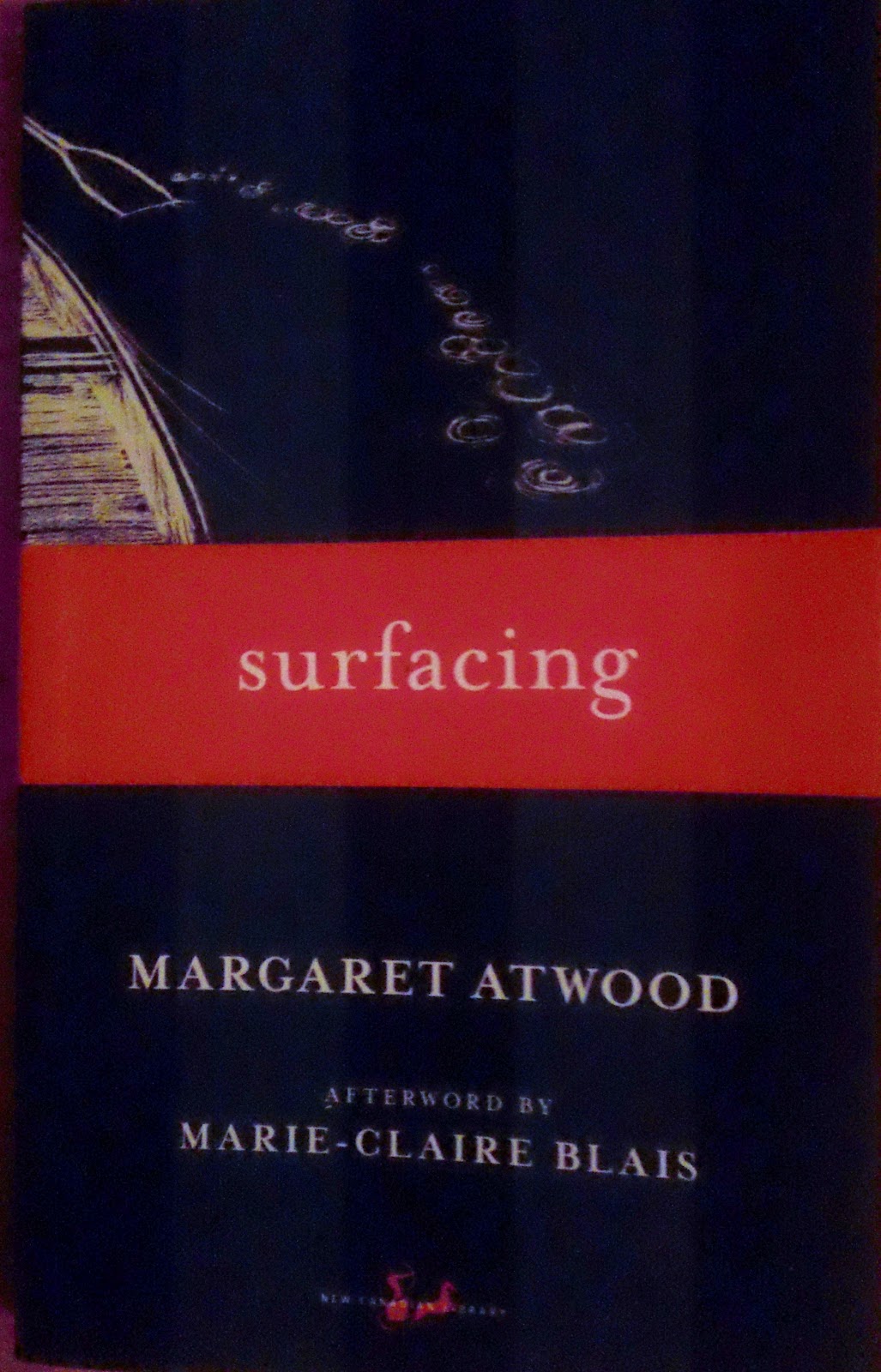
Book: Surfacing


McClellard and Stewart 1st Edition
Author: Margaret Atwood
Publisher: McClellard and Stewart
Year: 1972


Margaret Atwood's Surfacing is a novel about a woman rediscovering her roots in the wooded Quebec landscape. Forced to return to her parents' cottage after her father disappears, the unnamed narrator finds herself flooded with memories. She brings along her boyfriend and another couple to help in her search. As the week progresses, the narrator becomes less connected with reality.

Atwood is Canada's most well-known author. Born in Ottawa in 1939, she resides in Toronto. She began her career as poet and slowly moved onto novels. Surfacing was her second novel, but her best known work would probably be A Handmaid's Tale (1985).

Surfacing was said to be inspired by her childhood trips to Northern Canada. A major focus in Atwood's writing is Canadian identity. She wanted to identify a national literature for Canada that separates itself from American literature. Characters in Surfacing hate Americans and their infiltration on Canadian culture.

Some other themes in Atwood's writing are femininity, environmental concerns, and the importance of storytelling. Much of Canadian literature is about survival particularly in the wilderness.

Her female protagonist is very distant. Her voice is unnatural and unemotional. She seems to be void of love, comfort, and happiness. The narrator also has difficulties deciphering between reality and her imagination. She tells her boyfriend, Joe that she was once married and had a child. It is later revealed that she had an affair with a married man and an abortion. She also dwells on her brother 's drowning at the cottage, but again the reader learns he is actually still alive.

New Canadian Library Edition 1994

Surfacing is a quick read, but lacks any real connection with the audience. With a lot of narration, when character dialogue does occur it isn't enjoyable. Of the four main characters, none are very likable. This book leaves you wanting to avoid a couples cottage week.
Related Posts Plugin for WordPress, Blogger...